---
title: The Structural Gaps in Enterprise IAM | Opnova
description: Most IAM programs focus on provisioning, but risk concentrates elsewhere. Learn where identity governance breaks down and how lifecycle alignment reduces exposure.
image: https://opnova.ai/hubfs/bryan-goff-aoNuIXxWItQ-unsplash.jpg
---
[Skip to content](https://opnova.ai/blog/the-structural-gaps-in-enterprise-iam#main-content)
[Platform](https://opnova.ai/platform) [Resources](https://opnova.ai/blog) [About](https://opnova.ai/about-us)
[Contact us](https://opnova.ai/contact)
[Platform](https://opnova.ai/platform) [Resources](https://opnova.ai/blog) [About](https://opnova.ai/about-us)
[Contact us](https://opnova.ai/contact)
Blog
# The Structural Gaps in Enterprise IAM
Most IAM programs focus on provisioning, but risk concentrates elsewhere. Learn where identity governance breaks down and how lifecycle alignment reduces exposure.

Author Sinan Eren
Date 27 February, 2026
Ready to Govern Every Application?
See how Opnova can automate identity governance for your disconnected applications in weeks, not months.
[Request a Demo](https://opnova.ai/contact)
Most IAM programs optimize provisioning workflows; however, the greatest governance risk does not originate within provisioning itself. It concentrates at the structural boundaries of the identity lifecycle: before identity creation, during role transitions, and after termination.
Identity governance becomes fragile when the technical layer operates without alignment to business intent. At small scale, informal coordination can compensate for these gaps, but at enterprise scale, those same gaps compound into systemic risk, and automation only accelerates the exposure.
### Key Takeaways
- Identity governance begins with trust establishment, not account creation.
- Risk concentrates before onboarding, during role transitions, and at offboarding.
- Provisioning efficiency without lifecycle alignment increases residual exposure.
- AI agents inherit existing permission structures; they do not correct them.
- Automation strengthens governance only when lifecycle discipline exists first.
## Why Do Most IAM Programs Break Down at Scale?
In most large organizations, IAM infrastructure appears healthy: workflows execute, approvals are captured, and connectors synchronize accounts across systems without visible failure.
IAM tools perform mechanical operations well:
- Create accounts
- Assign entitlements
- Remove access
- Run certification campaigns
These capabilities are necessary, but they are not sufficient on their own.
Identity governance becomes fragile when the technical layer operates without alignment to business intent. At a small-scale startup, informal coordination among HR, IT, and Security can compensate for structural gaps, but at an enterprise scale, those gaps compound into significant systemic risk.
Provisioning velocity increases, risk visibility declines, and the breakdown accumulates quietly through entitlement drift, incomplete role transitions, and unmanaged external systems.
## What IAM Breakdown Means for the Business
IAM breakdown, in practice, is a gradual loss of confidence that access across the enterprise reflects current roles, responsibilities, and risk expectations.
Access that no longer reflects current responsibilities increases the likelihood of internal control failures. Permissions retained from prior roles expand the scope of data and systems exposed through a single account. Conflicting privileges introduced over time weaken safeguards designed to prevent fraud or error. Accounts that remain active in external or legacy systems extend exposure beyond the organization’s direct visibility.
As organizations increasingly deploy AI agents to perform operational tasks, this misalignment becomes even more consequential. Agents inherit the permissions and access structures that already exist. When those structures are inconsistent, outdated, or poorly reconciled, automation does not correct the problem; it scales it. The proliferation of AI agents will amplify existing governance gaps unless identity lifecycle discipline is established first.
## IAM Within the Business Operating Model
The challenges outlined above share a common root cause: identity is often managed as a technical workflow instead of being explicitly aligned to the organization’s operating model. Provisioning, approvals, and access reviews are treated as discrete operational tasks, even though they are the downstream expression of broader organizational decisions.
In reality, identity governance begins long before an account is created and extends well beyond the moment access is removed. It starts with a business decision to introduce a new person or entity into the organization’s operating environment. That decision carries implications for trust, compliance, and risk that must be reflected consistently across systems, processes, and time.
The identity lifecycle is a downstream enforcement layer of the organization’s operating model. Each stage, from initial authorization through role changes to eventual exit, represents a point where access should be validated against current responsibilities and risk expectations.
Most IAM programs invest heavily in the provisioning stage because it is the most visible and measurable. However, the greatest exposure often exists in the stages that precede and follow provisioning. Trust validation, contextual access decisioning, ongoing alignment, and complete containment are all essential components of effective governance, yet they are rarely modeled as part of a single, unified process.
When the identity lifecycle is explicitly aligned to the organization’s operating model, access decisions consistently reflect business intent at every stage. Without that alignment, the identity lifecycle becomes a series of technical events disconnected from the conditions that triggered them. Organizations then rely on periodic reviews to correct misalignment after it has already accumulated, rather than preventing it through structured continuity between business decisions and identity enforcement.
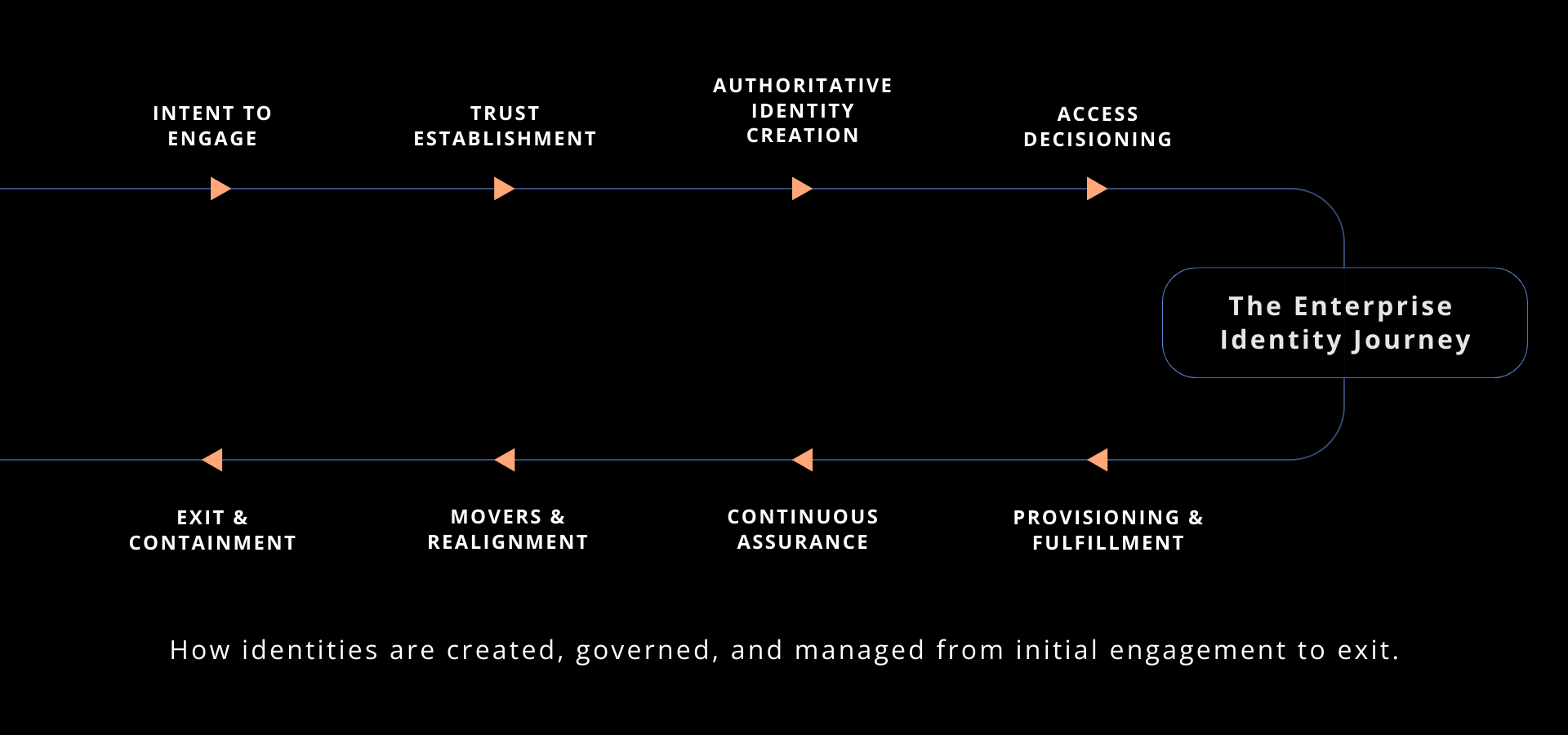
## Where Risk Concentrates in the Identity Lifecycle
When identity is viewed as a lifecycle, exposure does not accumulate evenly. Risk concentrates at specific stages where business intent, technical enforcement, and operational execution are most likely to diverge.
These concentration points are predictable and preventable.
### 1. Trust Establishment: Risk Before Identity Exists
The first concentration point occurs before identity creation, while establishing trust.
Hiring, contractor onboarding, and vendor engagement are governance decisions. They determine whether to introduce a new actor into the organization’s operating environment and under what conditions. If eligibility, role scope, regulatory constraints, or risk classification are not clearly defined at this stage, every downstream access decision is built on incomplete context.
When trust validation is weak, identity is created without a clearly bounded risk posture. That misalignment carries forward into provisioning and persists throughout the lifecycle.
### 2. Role Transitions: Accumulated Access and Control Gaps
A second concentration point emerges during role transitions.
As individuals move between teams or responsibilities, new access is typically granted quickly to maintain productivity. Removal of outdated privileges, however, is often less predictable. Over time, this creates residual access that no longer reflects current responsibilities.
The broader a user’s access footprint becomes, the greater the consequences if that access is misused or compromised.
In many environments, separation-of-duties conflicts are introduced incrementally during transfers. Permissions accumulate across functions that were never intended to overlap, weakening internal control safeguards without triggering immediate operational failure.
### 3. Long-Tail Systems and External Platforms: Execution Gaps
A third concentration point involves systems that sit outside centralized IAM integration.
Enterprises commonly rely on:
- Government regulatory portals
- Insurance exchanges
- Lending platforms
- Vendor-managed systems
- Legacy UI-only applications
These environments are often operationally critical but lack federated identity and structured API or SCIM integration. As a result, they frequently fall outside automated aggregation and consistent enforcement processes.
Even when access policies are well-defined, execution across these systems may remain manual, inconsistent, or dependent on brittle automation approaches. The result is uneven governance coverage across the identity surface.
### 4. Offboarding and Containment: Shadow Access Persistence
The final concentration point occurs during offboarding.
Disabling a primary directory account does not guarantee that access has been removed everywhere identity exists. In non-integrated systems and external platforms, access can persist beyond the individual’s relationship with the organization. For example, a former employee may retain credentials to a state regulatory filing portal, a lending exchange, or a vendor-managed SaaS platform that was never federated through the centralized IAM solution.
In some cases, these residual accounts operate outside standard monitoring processes, effectively becoming shadow accounts. They may retain visibility into sensitive data, regulatory filings, or competitive information long after termination.
IAM failures most often surface during audit, breach investigation, regulatory review, or insider incidents, long after the underlying misalignment has accumulated.
### How AI & Automation Should Support Identity Governance
AI and automation are increasingly central to how organizations manage identity at scale. As the volume of access requests, role changes, and system interactions grows, manual processes alone cannot maintain consistency or speed. Automation improves operational efficiency, while AI introduces new opportunities to streamline decision-making and execution.
However, neither AI nor automation inherently improves governance. Both amplify the structure within which they operate.
When identity lifecycle discipline is weak, AI and automation accelerate the same misalignment that already exists. Access is granted more quickly, but without stronger alignment to business intent. Role changes occur more frequently, yet residual access is not consistently removed. Offboarding actions execute faster, while gaps in external systems remain unresolved. In these environments, technology increases velocity without improving control.
When lifecycle discipline is strong, AI and automation reinforce consistency and extend governance across systems. They reduce manual work, support more reliable execution, and ensure that access changes reflect current roles and responsibilities. Technology becomes an extension of governance rather than a substitute for it.
The effectiveness of AI and automation in identity management, therefore, depends less on the tools themselves and more on the structure they support. Without a clear lifecycle model, defined ownership, and consistent execution standards, AI and automation will scale existing weaknesses. But with those elements in place, they become powerful tools for maintaining alignment between access and intent.
As automation becomes foundational to enterprise operations, identity lifecycle discipline becomes a prerequisite for scale. Governance strength will be determined by how consistently access reflects business intent across time and systems.
[Home](https://opnova.ai/)
- [Problem](https://opnova.ai/#problem)
- [Transformation](https://opnova.ai/#mission)
- [Solution](https://opnova.ai/#solution)
[Platform](https://opnova.ai/platform)
- [Technology](https://opnova.ai/platform#core-technology)
- [Use Cases](https://opnova.ai/platform#use-cases)
- [Deployment](https://opnova.ai/platform#deployment)
- [AI Safety](https://opnova.ai/platform#security)
[Resources](https://opnova.ai/blog)
- [All](https://opnova.ai/blog)
- [Blog](https://opnova.ai/blog#blog)
- [Documents](https://opnova.ai/blog#documents)
- [Videos](https://opnova.ai/blog#videos)
[About](https://opnova.ai/about-us)
- [Mission](https://opnova.ai/about-us#mission)
- [Team](https://opnova.ai/about-us#team)
- [Advisors & Investors](https://opnova.ai/about-us#advisors)
© OPNOVA All Rights Reserved | [Privacy Policy](https://opnova.ai/privacy-policy) | [Terms of Service](https://opnova.ai/terms-of-service) | [Status](https://status.opnova.io/)

AI startup program Google Cloud

NVIDIA DGX Cloud Innovation Lab
```json
{
"@context" : "https://schema.org",
"@type" : "BlogPosting",
"author" : {
"@type" : "Person",
"name" : "Sinan Eren",
"url" : "https://opnova.ai/blog/author/sinan-eren"
},
"dateModified" : "2026-03-31T23:14:03.021Z",
"datePublished" : "2026-02-27T00:00:00.000Z",
"headline" : "The Structural Gaps in Enterprise IAM",
"image" : [ "https://opnova.ai/hubfs/bryan-goff-aoNuIXxWItQ-unsplash.jpg" ],
"mainEntityOfPage" : {
"@id" : "https://opnova.ai/blog/the-structural-gaps-in-enterprise-iam",
"@type" : "WebPage"
},
"publisher" : {
"@type" : "Organization",
"logo" : {
"@type" : "ImageObject",
"url" : "https://opnova.ai/hubfs/logo%203.png"
},
"name" : "Opnova"
}
}
```