Extending IAM beyond APIs: how non-integrated systems create execution gaps, increase risk, and why governance requires consistent, policy-aligned control across the full identity lifecycle.

This is Part 2 of our IAM series. In Part 1, we explored why identity governance breaks down at scale, specifically how risk accumulates at the boundaries of the identity lifecycle. This piece focuses on what it takes to actually fix it.
Traditional IAM automation performs well in integrated, API-connected systems, yet a significant portion of enterprise identity activity occurs outside those environments.
Regulatory portals, vendor-managed platforms, and legacy UI systems create execution gaps that undermine the integrity of the identity lifecycle. When policies translate cleanly in integrated systems but degrade into manual execution elsewhere, AI agents inherit that fragmentation and propagate it across the identity surface.
Extending deterministic, policy-aligned execution into non-integrated systems is essential for maintaining governance parity across the full identity surface.
Key Takeaways
-
Traditional IAM platforms are strongest in integrated environments where policies translate cleanly into execution.
-
Non-integrated systems create structural execution gaps.
-
Manual processes and brittle RPA introduce inconsistency and audit risk.
-
AI agents require guardrails and traceability across all environments.
-
Governance strength is constrained by the weakest execution layer.
The Structural Coverage Gap in Enterprise IAM Architecture
IAM platforms were designed around integration. Their architecture assumes that identity decisions can be translated into system-level enforcement through APIs, connectors, and structured interfaces.
In environments where those integrations exist, governance operates predictably. Separation-of-duties controls can be evaluated. Roles can be enforced consistently. Access changes can be reconciled and validated. Within integrated systems, policy intent and technical execution remain closely aligned.
However, most enterprise operating environments extend far beyond those boundaries.
Modern enterprises depend on a wide range of operationally critical systems that lack structured integration layers, including:
-
Government regulatory portals
-
Insurance and compliance exchanges
-
Lending and financial transaction platforms
-
Vendor-managed portals and SaaS applications without API or SCIM access
-
Legacy applications accessible only through user interfaces
These systems often sit outside centralized IAM controls. They may support core revenue operations, regulatory filings, or partner workflows, yet lack API or protocol-level enforcement mechanisms.
Even when access policies are well defined, execution across these environments frequently relies on manual coordination, ticket-based processes, or brittle automation approaches like RPA that are sensitive to interface changes.
Integrated systems operate under deterministic governance. Non-integrated systems operate under inconsistent enforcement. Over time, this divergence creates a structural gap between policy intent and operational reality across the enterprise identity surface.
AI agents bring scale to identity operations, but they also increase the cost of inconsistent enforcement. When policies translate cleanly in integrated systems and degrade into manual execution elsewhere, agents inherit that fragmentation and propagate it across the identity surface.
AI & Automation Coverage Across the IAM Lifecycle
The effectiveness of AI and automation in identity governance depends on two structural variables: how well systems are integrated and how the decisions associated with access are made. Understanding these dimensions clarifies where traditional IAM automation performs well and where governance gaps are most likely to persist.
The following framework illustrates how automation coverage varies across the identity surface.
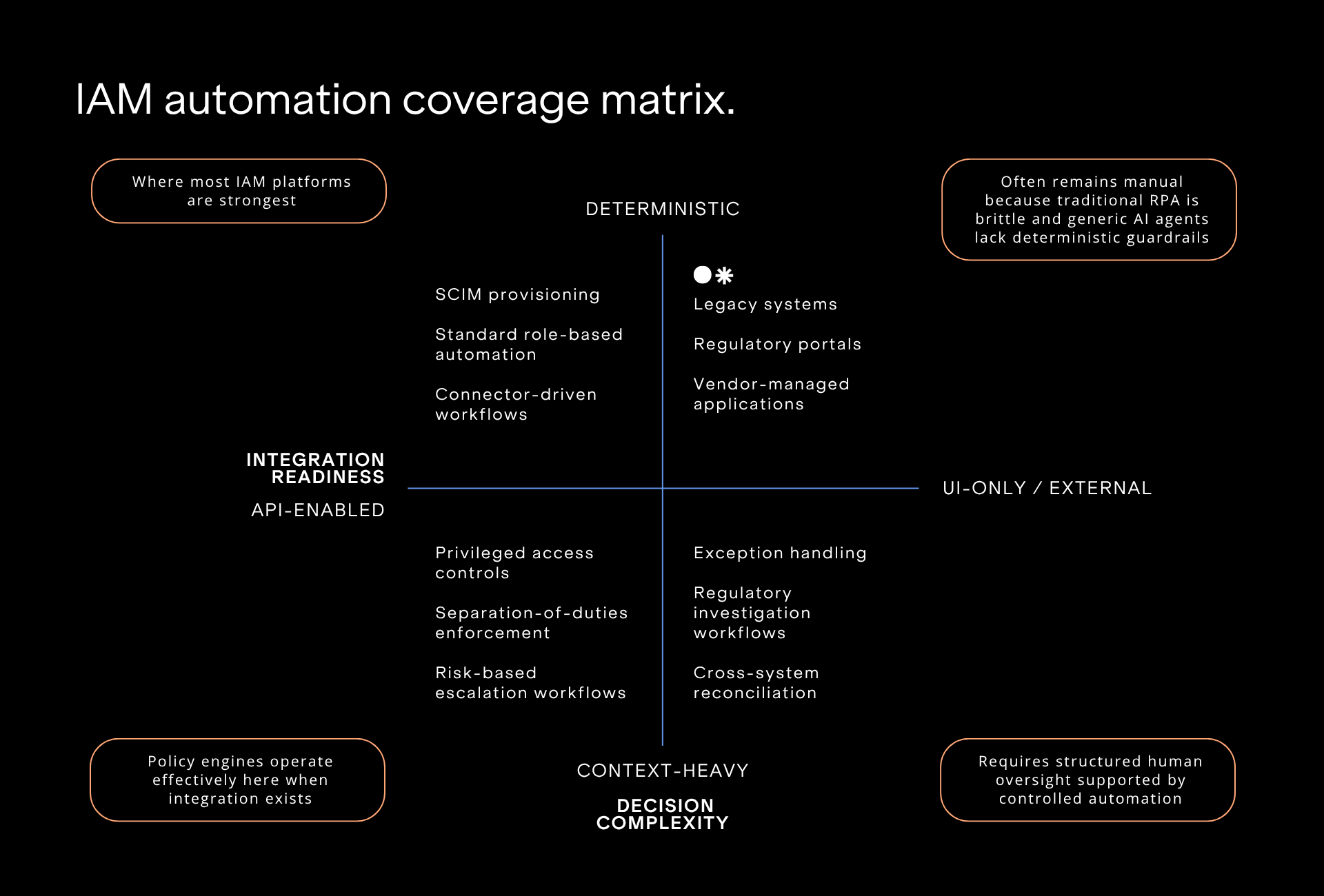
The matrix highlights a structural pattern common in mature IAM environments. Traditional IAM platforms perform well in integrated systems where decisions can be expressed deterministically. In these environments, connectors, APIs, and templates allow policies to translate cleanly into execution.
The challenge emerges in non-integrated environments. Many enterprises depend on regulatory portals, legacy systems, and vendor-managed applications that do not expose structured interfaces. Even when the underlying access decision is straightforward, execution across these systems remains manual or inconsistently automated. Traditional RPA approaches often fail because they are brittle and sensitive to interface changes. Generic AI agents introduce flexibility but may lack deterministic guardrails and audit traceability.
This non-integrated, deterministic quadrant represents a structural coverage gap. Policies may be defined correctly, yet execution across the full identity surface remains uneven.
In more complex workflows, particularly those involving cross-system reconciliation or regulatory exceptions, contextual judgment is often required. Integrated environments can support policy engines that enforce separation-of-duties and risk-based controls. Non-integrated environments require structured human oversight supported by controlled automation and traceability.
Understanding these quadrants clarifies a central point: governance strength depends not only on policy design, but on the ability to execute those policies consistently across every environment where identity exists.
Where Opnova Extends Governance Coverage
Governance strength is constrained by the weakest link in the identity landscape. The automation coverage matrix highlights a structural gap that exists in many IAM programs: a significant portion of enterprise identity activity occurs in environments that do not expose modern integration interfaces.
Legacy applications, regulatory portals, and vendor-managed platforms and SaaS applications without API or SCIM access often require direct interaction through user interfaces. In these environments, policies may be well-defined, yet execution remains manual, inconsistent, or dependent on brittle automation approaches. As AI agents are introduced to increase operational scale, these gaps become more consequential.
Opnova extends governance coverage into this non-integrated execution layer.
Rather than redefining identity policy, it operates at the point of execution, ensuring that access changes defined by governance frameworks are applied consistently across systems that lack structured APIs. By enabling deterministic, guardrail-based interaction with UI-based environments, it closes the gap between policy intent and operational reality.
This extension of coverage is critical in environments where:
-
Access must be reconciled across integrated and non-integrated systems
-
Offboarding requires containment in external or regulatory platforms
-
Role transitions demand consistent removal and reassignment across heterogeneous environments
-
Audit traceability must span every system where identity exists
By reinforcing execution consistency across the full identity surface, Opnova enables AI and automation to extend governance rather than undermine it.
Strategic Implications for CISOs
For CISOs and security leaders, the evolution of identity governance is no longer a tooling discussion; it is a structural one.
A mature IAM strategy must move beyond provisioning efficiency and answer a set of foundational questions:
-
How is trust validated before identity creation?
-
How are role transitions reconciled consistently and deterministically?
-
How are non-integrated systems governed alongside API-connected platforms?
-
Where does residual access accumulate over time, and how is it identified?
-
Does automation extend governance coverage or merely accelerate provisioning activity?
These questions define whether identity governance functions as a control framework or as an operational workflow.
Organizations that model IAM as a cross-functional lifecycle, supported by consistent execution across every system where identity exists, achieve measurable advantages:
-
Reduced residual access and privilege accumulation
-
Lower audit preparation effort and cost
-
Provable containment during offboarding, including external systems
-
Governance parity across integrated and non-integrated environments
-
Greater resilience as workforce mobility and AI-driven automation increase complexity
As enterprises introduce AI agents, expand digital partnerships, and rely on increasingly heterogeneous platforms, the integrity of that trust model becomes even more consequential. Lifecycle alignment and execution coverage have become prerequisites for ensuring that access reflects intent across the full operational surface of the enterprise.
For CISOs, the mandate is clear: identity governance must be designed not only for scale, but for structural integrity.
Part 1 outlined where identity governance breaks down. Part 2 focuses on rebuilding it with lifecycle alignment. Together, they form the foundation for a more resilient IAM model.